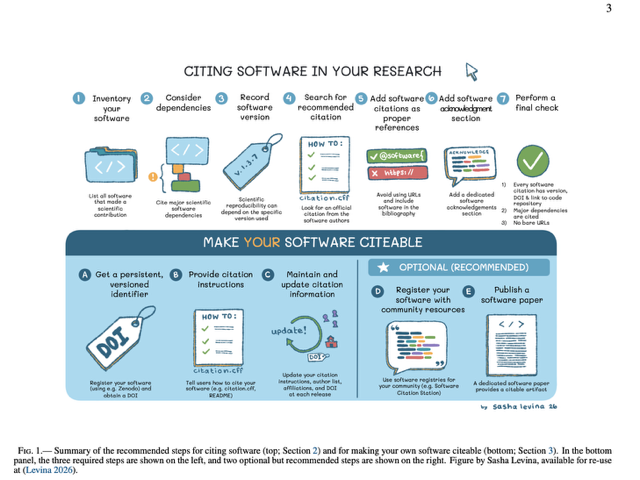
Software forms the foundation of modern research, yet citing code effectively remains a challenge across scientific disciplines. Following the 2026 Software Citation Workshop hosted at UCSD and supported by NASA, our team published a practical guide titled “A Practical Primer on Software Citation in Research.” It outlines a 7-step workflow for researchers and a 5-step framework for developers, taking pragmatic positions on several grey areas in research software citation.
1. How far down the dependency tree should you cite?
A common dilemma is deciding which underlying libraries warrant formal citation. Top-level libraries that directly shape your pipeline should always be formally cited. Foundational infrastructure (NumPy, SciPy, Astropy) should be cited when a specific routine plays a dominant role in your result. Deep dependencies generally do not require individual citations. Instead, scientific reproducibility is preserved by recording complete versions in environment configuration files (e.g., requirements.txt).
2. Adapting maintainers’ preferred citations
While traditional advice suggests following a maintainer’s instructions strictly, we advocate for a more proactive approach: follow the intent, but adapt the format to meet citation standards. Authors are encouraged to supplement requests by adding Zenodo DOIs, explicit version numbers, or commit hashes to ensure the citation functions as a traceable reference.
3. Solving the GitHub-Zenodo metadata lag
Automatic archiving integrations like the GitHub-Zenodo webhook mint a version-specific DOI after a release is published. As a result, the CITATION.cff file cannot contain its own version DOI, leaving metadata one release behind. To resolve this, developers can use tools like Codefair to generate and write the version-specific DOI directly into CITATION.cff prior to publishing.
5. AI and Model Influence Statements
As AI-assisted workflows become common in code development and drafting, disclosure standards are essential. We advocate for explicit disclosures or voluntary Model Influence Statements, detailing how models were used, such as for grammar editing and figure concept brainstorming.
Read the full primer
For the complete 7-step citation checklist, 5-step developer guide, and worked examples, read the full paper on arXiv.