SLIC superpixels on the HEALPix grid
A recent healpy issue proposes a slic function
that generates superpixels on the HEALPix grid, adapting the SLIC algorithm to the sphere, with a
complete working implementation attached. This post is what I found testing it.
What are superpixels, and what is SLIC?
In 2D image processing, superpixels oversegment an image into a few hundred small, contiguous regions that group neighbouring pixels with similar values: instead of working with millions of pixels, a downstream classifier or segmenter works with a few hundred coherent regions that mostly respect image edges.
SLIC (Achanta et al. 2012) is the most widely used superpixel algorithm, an adapted k-means: each pixel is assigned to the cluster centre minimising a joint feature + spatial distance
where is the difference in map value(s), is the angular distance between pixel and centre (the spherical twist), is the compactness parameter, and is the nominal spacing of superpixels covering a valid fraction of the sphere.
- Large compactness: the spatial term dominates and superpixels become compact, regular and grid-like.
- Small compactness: superpixels follow the contours of the map.
- Only pixels within 2S of a centre are compared, so an iteration costs ~O(npix): this local search is what makes SLIC fast, also on the sphere.
The proposed implementation works directly on the HEALPix grid in RING or NESTED ordering, supports masked maps and multi-feature stacks, and offers three ways to place the initial centres: greedy k-means++ seeding (random), farthest-point sampling, and hierarchical seeding at the centres of the coarser HEALPix level closest to the requested number of segments (deterministic and ordering-independent). The same idea exists in the computer-vision literature as SphSLIC, for 360-degree panoramic images (Zhao et al. 2018).
The three initialisation strategies converge to very similar partitions (black dots are the final centres of each superpixel):

More superpixels just shrink the regions:

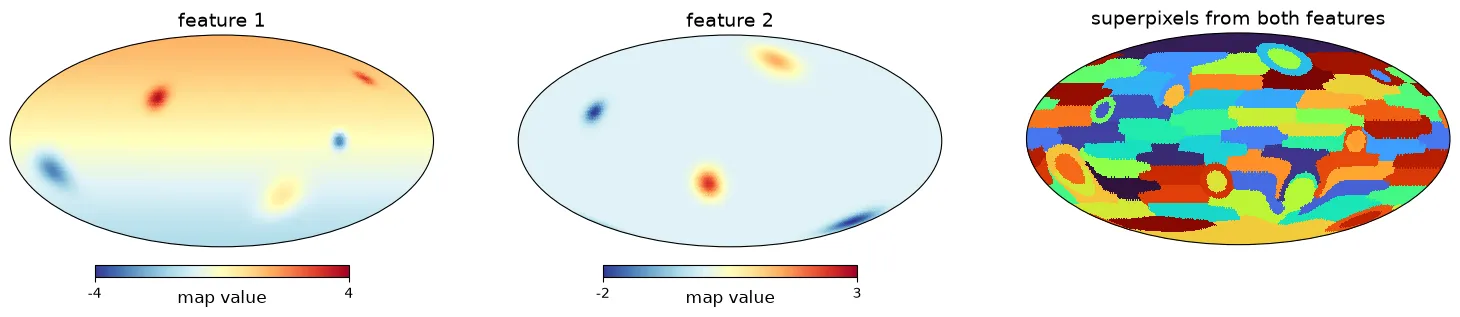
Clustering can also run on a stack of maps, in the combined feature space:
Findings
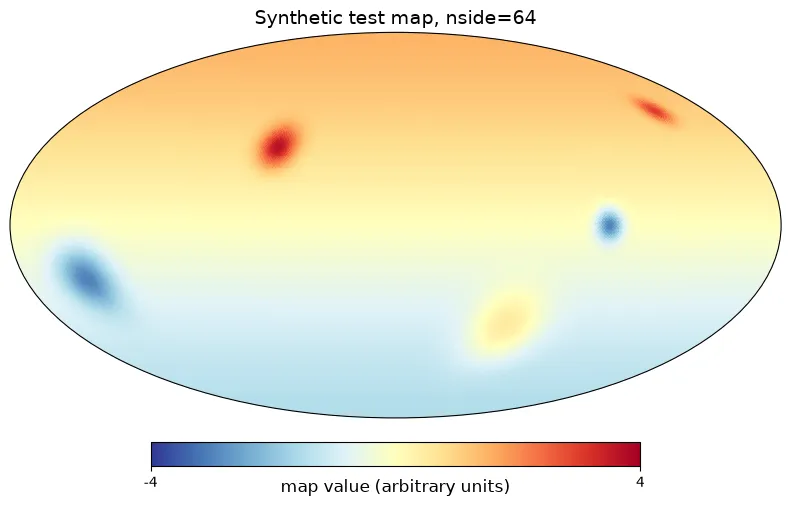
All examples use a synthetic nside=64 map, a large-scale gradient plus Gaussian blobs:
-
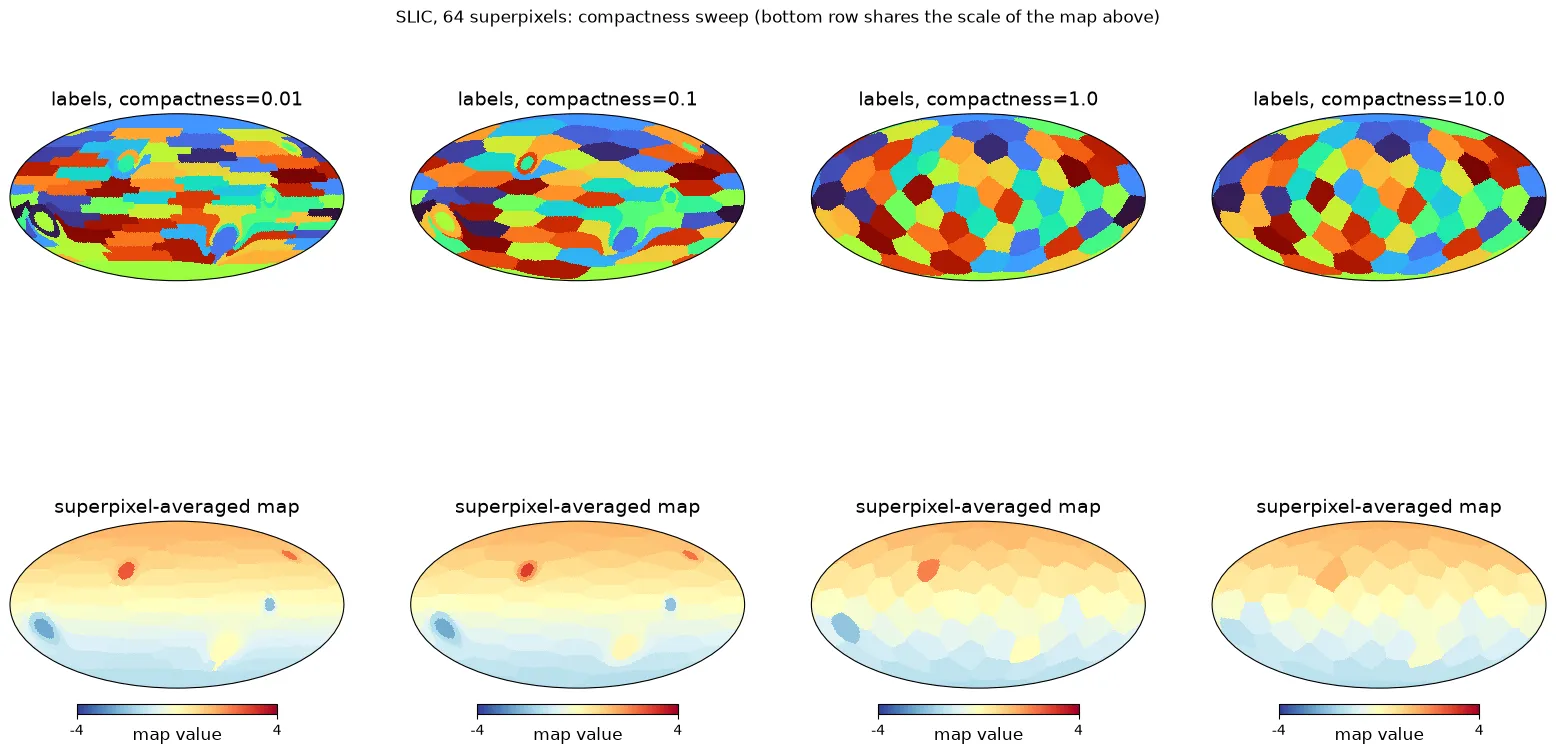
Compactness is the knob: at 0.01 superpixels stretch along map contours and the superpixel-averaged map is nearly identical to the input; at 10 the segmentation degenerates into a quasi-regular sky partition, a fancier ud_grade. Intermediate values give roughly round superpixels that still snap to strong edges.
Top row: superpixel labels. Bottom row: superpixel-averaged map, same colour scale as the test map:
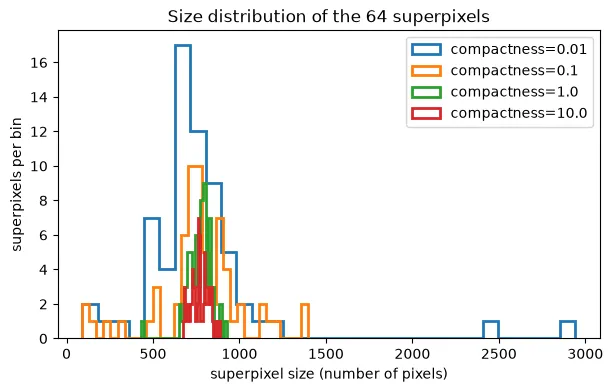
Size distributions tell the same story, regular cells at high compactness, all scales at low compactness:
-
Fast: nside=256 (786,432 pixels), 64 superpixels, ~29 s.
-
RING vs NESTED: hierarchical seeding is ordering-independent by construction, but exact gradient ties in the low-gradient nudge (which moves seeds off edges) are broken by candidate order, so partitions come out 87% identical, not 100%. Same quality either way; a deterministic tie-break would fix it.
-
compactness=0 gives divide-by-zero warnings and an all-unassigned result; negative values silently behave like their absolute value (the feature term is squared). Needs validation.
-
compactness carries the units of the map: scaling the map by 1000 with the same compactness drops agreement to 61%; scaling compactness along with the map reproduces the segmentation exactly. A CMB map in K vs uK needs completely different values, so normalising features internally would make compactness dimensionless.
-
Connectivity is not guaranteed (inherent to SLIC, same in 2D): 3/64 superpixels came out spatially disconnected. SNIC (Achanta & Sustrunk 2017) enforces connectivity if needed.
-
Duplicate centres can occur after the seed nudge, silently giving fewer superpixels than requested.
-
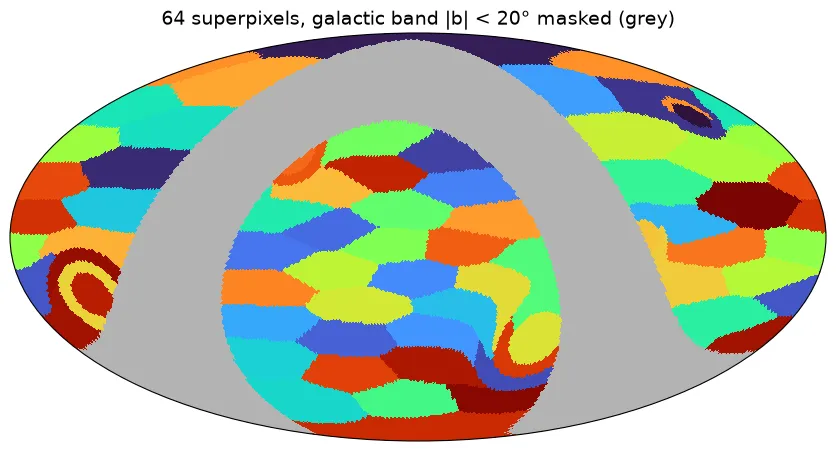
Sparse masks are fine: the nominal spacing is rescaled by the valid fraction, and a polar-cap test assigned 100% of valid pixels with all clusters used.
Here a 40-degree galactic band is masked out (grey):
Verdict
Works, fast, sensible segmentations; init=‘hierarchical’ is a good deterministic default. Worth discussing in the issue: naming (hp.slic vs superpixels()), internal feature normalisation, exposing per-superpixel means as an output, citing Zhao et al. (2018) as prior art.
References
- Achanta et al. (2012), SLIC Superpixels Compared to State-of-the-Art Superpixel Methods, IEEE TPAMI 34(11), 2274-2282: https://doi.org/10.1109/TPAMI.2012.120
- Ren & Malik (2003), Learning a Classification Model for Segmentation, IEEE ICCV: https://www2.eecs.berkeley.edu/Research/Projects/CS/vision/grouping/papers/ren_malik_iccv03.pdf
- Arthur & Vassilvitskii (2007), k-means++: The Advantages of Careful Seeding, ACM-SIAM SODA: https://theory.stanford.edu/~sergei/papers/kMeansPP-soda.pdf
- Zhao et al. (2018), Spherical Superpixel Segmentation, IEEE Trans. Multimedia 20(6), 1406-1417: https://doi.org/10.1109/TMM.2017.2772842
- Wan et al. (2018), Spherical Superpixels: Benchmark and Evaluation, ACCV, LNCS 11366, 703-717: http://cic.tju.edu.cn/faculty/lwan/paper/sphsp18/SphSP.html
- Giraud et al. (2020), Generalized Shortest Path-based Superpixels for Accurate Segmentation of Spherical Images, ICPR: https://arxiv.org/abs/2004.07394 (journal version, Pattern Recognition 2023: https://arxiv.org/abs/2509.19895)
- Achanta & Sustrunk (2017), Superpixels and Polygons Using Simple Non-Iterative Clustering, IEEE CVPR: https://openaccess.thecvf.com/content_cvpr_2017/html/Achanta_Superpixels_and_Polygons_CVPR_2017_paper.html
- Stutz et al. (2018), Superpixels: An Evaluation of the State-of-the-Art, CVIU 166, 1-27: https://arxiv.org/abs/1612.01601
- Gorski et al. (2005), HEALPix, ApJ 622, 759-771: https://doi.org/10.1086/427976